Why You Should Avoid Visiting the Temple of Artemis — History & Risks
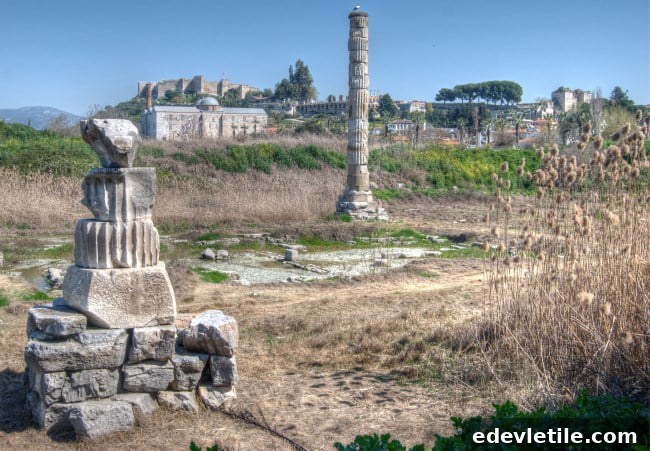
Antipater of Sidon, a noted Greek poet from the latter half of the 2nd century BC, visited many famous sites of the ancient world, including the Temple of Artemis near the ruins of Ephesus in Selçuk on Turkey’s Aegean coast.
Also called the Temple of Diana, the sanctuary honoured Artemis, goddess of fertility. It was rebuilt several times and stood in various forms until its final destruction in AD 401. By the medieval period, the temple had been forgotten: centuries later, remains were scarcely known to locals and the site had largely vanished from collective memory.
In 1869 a British Museum–funded expedition rediscovered the location and excavations continued until 1874. Many of the recovered artefacts left the region during that period and are now exhibited at the British Museum in London. Accounts differ on whether those items were legally exported with Ottoman permission or removed under dubious circumstances while the empire was financially strained.
Visiting the Temple of Artemis
Antipater wrote after seeing the sanctuary:
“I have set eyes on the wall of lofty Babylon on which is a road for chariots, and the statue of Zeus by the Alpheus, and the hanging gardens, and the colossus of the Sun, and the huge labour of the high pyramids, and the vast tomb of Mausolus; but when I saw the house of Artemis that mounted to the clouds, those other marvels lost their brilliancy, and I said, ‘Lo, apart from Olympus, the Sun never looked on aught so grand.”
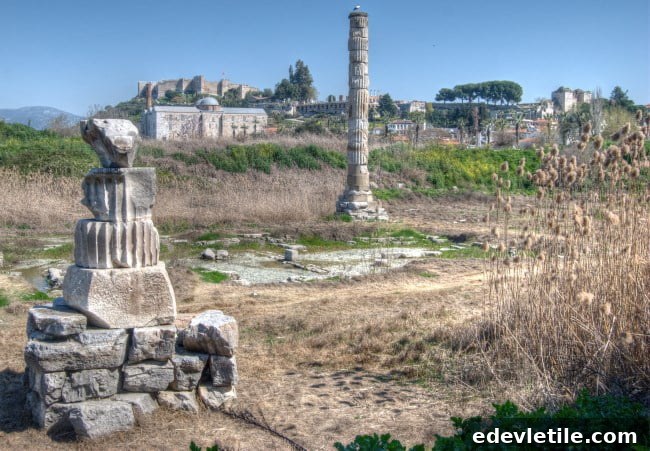
By contrast, modern visitors often find the current remains modest. The surviving traces and a single standing column contrast sharply with descriptions and reconstructions of the original monument.
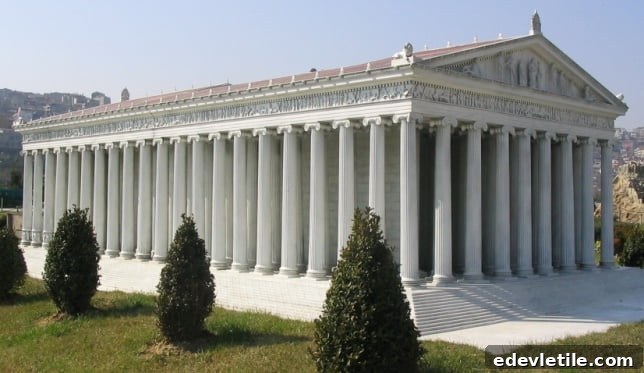
(Model of the Temple of Artemis at Miniaturk)
The site today offers a quiet, atmospheric experience rather than overwhelming grandeur. The surviving column is a reminder of the temple’s former scale, but visitors should not expect the towering structure described by ancient authors. Many who come to see the location report a mix of disappointment and fascination: the contrast between the ancient reputation and the present state prompts reflection on time, loss, and preservation.
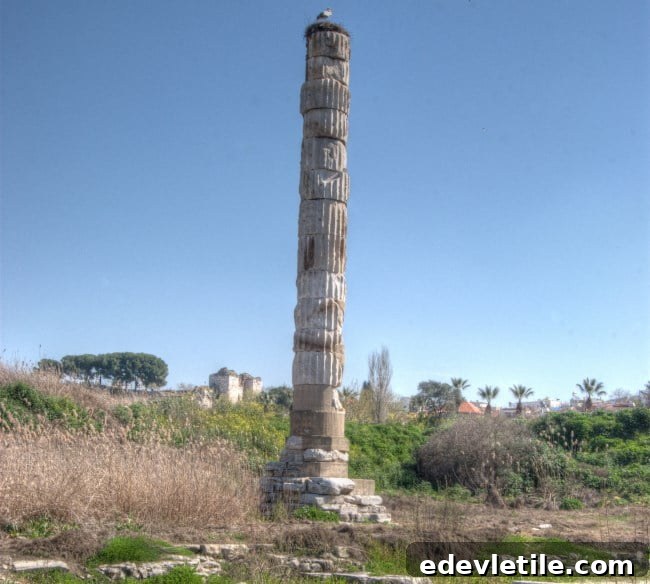
The small archaeological area is also a place to notice local wildlife and small details—a marsh-dwelling duck, turtles in the water, or a stork nesting atop the solitary column. Those natural scenes often charm visitors more than the ruins themselves. Local vendors sometimes try to sell souvenirs, and tourists should exercise caution when offered items that appear dubious.
Despite the modest remains, the Temple of Artemis remains significant for its historical reputation and archaeological potential. Scholars and enthusiasts hope that renewed excavation and conservation could reveal more about the temple’s layout and the treasures once housed there. Local reports have indicated plans for further archaeological work, prompted in part by low visitor numbers and renewed interest in preserving the site.
If you visit, the site can be a quick stop if you drive past the entrance; it’s not generally considered a destination that justifies a long detour. For those interested in ancient history and archaeology, however, the Temple of Artemis remains a compelling place to see—both for what survives and for what it once represented among the Seven Wonders of the Ancient World.
In the coming years further excavations may uncover more of the temple’s story. Until then, visitors can appreciate the site as a quiet, evocative link to a past that once inspired poets like Antipater to call it one of the greatest marvels of the ancient world.