Exploring the Ancient Theatre of Ephesus: Visitor Guide and Tips
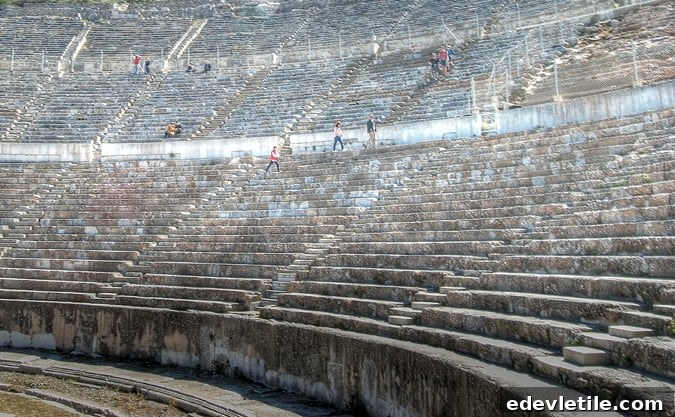
To be honest, the Ephesus theatre is not my favorite site. I find it difficult to admire a place that once hosted gladiator contests and animal fights, spectacles that celebrated violence and caused needless suffering for the sake of entertainment. That history makes it hard to view the theatre purely as a monument to human achievement.
Still, time has transformed the theatre’s role. Centuries have washed away those brutal practices, and today the Ephesus theatre stands as one of the largest surviving relics of the Roman world. Its scale and persistence command admiration and respect from visitors and historians alike.
Located on Turkey’s Aegean coast near Kuşadası and Selçuk, the theatre dates back to the Hellenistic period and was expanded by the Romans. It also appears in Biblical narratives: according to the Acts of the Apostles, events that unfolded here played a part in Saint Paul being driven out of the city. That mix of historical and religious significance makes the theatre a compelling subject for exploration.
About the Ephesus Theatre
Scholars estimate the theatre could accommodate around 24,000 spectators—about half the capacity of many modern football stadiums. The scale is striking: when you stand on the upper steps and look down into the semi-circular auditorium, the sheer size becomes unmistakable. The Romans achieved this impressive capacity without modern technology, relying on clever engineering and design.
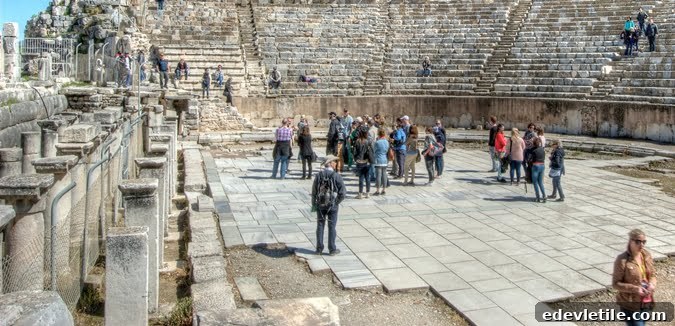
On my three visits to Ephesus I climbed to the top only once. During a scorching summer walk through the site, I declined the steep ascent and was content to view the stage and lower tiers. That vantage point still tells a powerful story: the theatre’s 30-metre-high backdrop creates exceptional acoustics, which have attracted modern performers such as Sting, Pavarotti and Elton John. Even today, the curved form amplifies sound in a remarkably effective way.
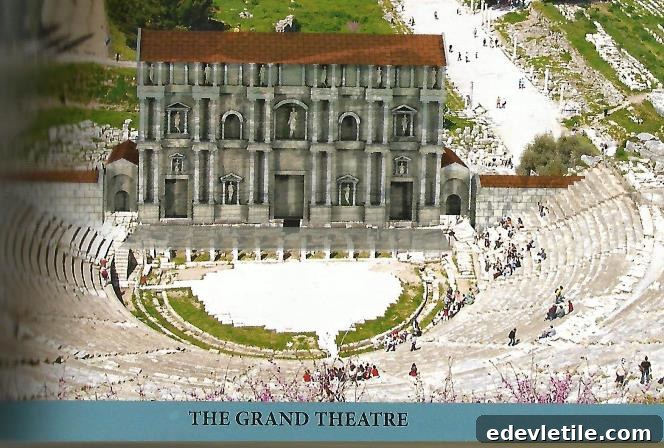
Much of the theatre’s finer architectural detail has been lost to earthquakes and the passage of time, but its monumental scale remains. I was pleased to find a reconstruction by archaeologist I. Akan Atila that imagines the theatre’s original façade. His drawing, published in his book Ephesus, Priene, Miletus and Didyma, helps visitors visualize the elaborately decorated front that once stood here.
Ephesus Theatre, Saint Paul and the Silversmith Riots
Whether or not one accepts the Biblical account, the story from Acts 19:23–41 offers a vivid portrait of how the theatre functioned as a social and political center. Imagine thousands packed into the tiers, their emotions swayed by performances, public debates or religious controversy. In this case, the controversy centered on a silversmith named Demetrius, who crafted and sold small statues of the goddess Artemis.
Paul’s message that “gods made by human hands are not gods at all” threatened Demetrius’s livelihood and the local economy tied to Artemis worship. Alarmed, Demetrius rallied fellow craftsmen, warning that Paul’s influence endangered both their trade and the reputation of the temple of Artemis, one of the ancient world’s great sanctuaries.
The crowd erupted, chanting “Great is Artemis of the Ephesians!” and massing in the theatre, demanding Paul’s appearance. His followers, fearing for his safety, kept him hidden. A city official eventually calmed the assembly by reminding them of the city’s role as guardian of the famed temple and its sacred image.
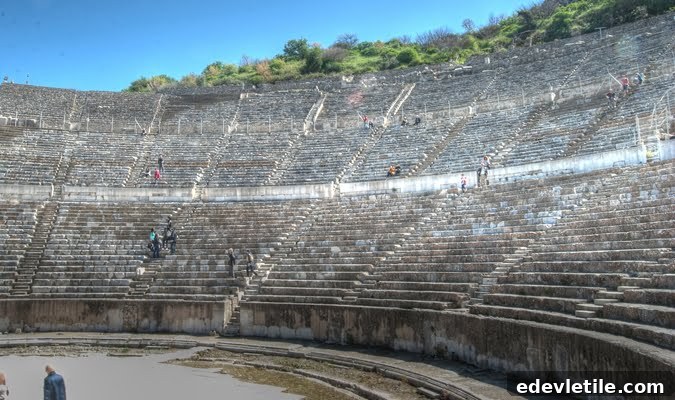
Paul soon left Ephesus amid concerns for his safety, though some accounts suggest different outcomes. Regardless of the exact historical truth, standing in the theatre invites visitors to imagine those tense moments. Rather than viewing the site as merely a pile of stones, it becomes easier to appreciate the theatre as the civic heart of one of antiquity’s greatest cities—where religion, commerce, politics and entertainment intersected.
Read more about my visits to Ephesus
- About the Celsus Library that once housed around 12,000 scrolls
- About the Roman terrace houses and their remarkable mosaics
- About other landmarks across the ancient city of Ephesus