Gallipoli and Anzac Cove: Poignant Photos That Remember the Fallen
Today’s post is by Ash Clark, a writer from Australia, who traveled to Turkey to take part in the Gallipoli and Anzac Cove remembrance day, a poignant reminder of the innocent casualties of war.
Brighton Beach, on the Turkish shore of the Dardanelles, is an unassuming stretch of sand. From the waterline to the land beyond, the terrain is essentially flat with no prominent features—making it, in military terms, an ideal spot for an amphibious landing.
Flat beaches like Brighton would normally allow troops to disembark quickly from transport ships and establish a secure beachhead without having to fight uphill against entrenched defenders. That simple geography shaped the expectations and the planning for the landings in April 1915.
The History of Gallipoli
At dawn on 25 April 1915, Allied forces from the United Kingdom, France, India, Canada, Australia and New Zealand attempted to seize the Gallipoli Peninsula and advance toward Constantinople, aiming to weaken the Ottoman Empire and open the Black Sea to Allied navies.
But planning failures, poor communication and navigational errors meant many troops went ashore north of Brighton, at a place that offered much steeper, more rugged terrain.
Confronted with harsh cliffs and a determined Ottoman Army, the invading troops were unable to secure a rapid advance. The campaign stalled into a brutal, months-long stalemate that ended only when Allied forces evacuated the peninsula eight months later.
The Death Toll
The Gallipoli campaign produced devastating losses across all sides. Casualties included approximately:
- 43,000 British
- 15,000 French
- 8,700 Australians
- 2,700 New Zealanders
- 1,370 Indians
- Around 60,000 Turkish fatalities
The landing area most associated with the Australian and New Zealand forces is now known as ANZAC Cove, named for the Australian and New Zealand Army Corps. For both nations, Gallipoli was their first major battle fought as separate national contingents and it left a lasting mark on their histories.
In Australia and New Zealand the campaign is often remembered as “our glorious defeat”: although the operation failed militarily, the courage and endurance shown by ANZAC troops became a central part of national identity for both countries.
Yearly Services
Every year on 25 April, Australia and New Zealand observe ANZAC Day. Dawn services and memorial ceremonies across both countries commemorate those who served and sacrificed, in a way comparable to Armistice Day in Europe or Veterans Day in the United States.
ANZAC commemorations at Gallipoli draw large numbers of visitors from Australia and New Zealand. The dawn service at Anzac Cove regularly attracts crowds well into the tens of thousands, as people come to remember and to stand in the same places where their ancestors fought.
Battle sites, cemeteries and memorials on the peninsula are maintained by the Commonwealth War Graves Commission and the Turkish government. Numerous guided tours operate in the region, offering balanced accounts from both sides of the conflict and explaining the significance of each site.
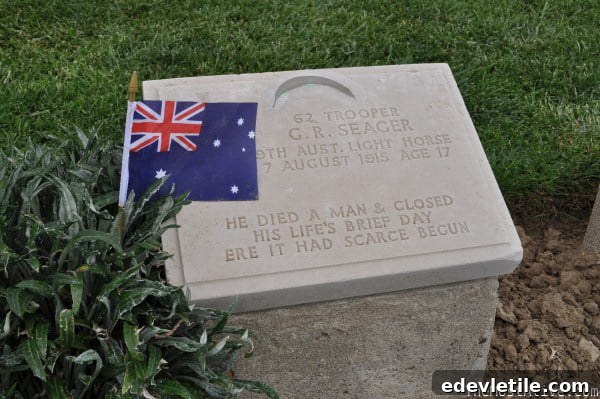
Visiting places such as the Turkish 57th Regiment memorial—a unit that suffered catastrophic losses—or reading the headstones of so many young soldiers makes the human cost unmistakable. Many of the graves belong to teenagers, underlining how young many of those who fought and died were.
What the ANZAC sites at Gallipoli commemorate is not the glory of battle but the qualities shown in the worst moments of war: courage, endurance and comradeship. Crucially, they also celebrate reconciliation between former enemies.
That spirit of respect and friendship was expressed by Mustafa Kemal Atatürk when he addressed the first visitors from Australia and New Zealand in 1934. His words acknowledged the shared sacrifice and offered comfort to grieving families:
“Heroes who shed their blood and lost their lives! You are now lying in the soil of a friendly country. Therefore rest in peace. There is no difference between the Johnnies and Mehmets to us where they lie side by side here in this country of ours. You, the mothers, who sent their sons from far away countries, wipe away your tears; your sons are now lying in our bosom and are in peace. After having lost their lives on this land they have become our sons as well.”
Gallipoli remains a deeply moving place. Its lasting legacy is the demonstration that former foes can become friends, and that remembrance can inspire unity rather than division.
May this site continue to inspire us to seek understanding among nations and cultures, without sacrificing our best in war.